友谊万岁! <3
Friday, October 23, 2009, 10:57 PM
Something my cousin emailed me recently:
给亲爱的你,
谢谢你曾经陪伴着我..~
谢谢你做我的朋友..^^
谢谢你让我的回忆更美满..
希望我们以后还能继续联络哦..
记得永远都不要忘记我哦....
以前,我们曾经一起吵架过..
以前,我们曾经一起闹纠纷过...
以前,我们曾经一起笑过...
以前,我们曾经一起分享过..
以前,我们曾经一起被罚过..
以前,我们曾经一起游戏过..
以前,我们曾经一起嬉戏过..
以前,我们曾经一起读书过..
以前,我们曾经一起活动过..
以前,我们曾经一起发神经过..
以前,我们曾经一起翘课过...
以前,我们曾经一起唱歌过..
以前,我们曾经一起表演过..
以前,我们曾经一起用餐过..
以前,我们曾经一起忙碌过...
以前,我们曾经一起做弊过..
以前,我们曾经互相挺立对方过..
以前,我们曾经互相包容过..
或许在这些事情当中...我们有些事情是没有一起经历过的...
可是我们还是很要好的朋友哦...
这份情谊是一生一世的...
许许多多的以前,许许多多的回忆..
如今将挂上一个美丽的句号...
这些回忆让我们的童年添加了色彩..
让我们都经过快乐,悲伤,忧虑,害怕...
期盼着要到的将来,
等待着要到的未来..
大家的友情,
永远都没有句号,
大家的友情,
永远都没有污点..
把每一份真诚的友谊,
都藏在心中..
你是我的朋友,我希望你知道这个是真的..
无论发生什么事,我都会站在你这里;
当你需要我的时候,我一定会出现,
给你援手,助你一臂..
有需要的时候尽管来找我..
不因为为什么,
只因为我们是朋友..
虽然我们毕业了,分离了.
不希望你忘掉我..
不希望你憎恨我..
只希望你记住我~
一定要记住哦!
希望我们友谊万岁~
有缘的话,咱们一定会再相遇..
相信我!我们一定会再相遇的~
try to zoom in if the words are too small
Hello all! Grad night was awesome!(:
Thank you all for being so enthusiastic throughout the whole ceremony with all the screamings(cheerings) :D
We are the BEST CLASS ever woohoo! (you can't deny that haha)
I am sure that grad night was memorable with all the photo-takings. (:
一個普通的朋友對你的羅曼史感到好奇。 一個真正的朋友可以威脅你說出來。
(HAHA so are we all good friends :p)
一個普通的朋友期望你永遠在他身邊陪他。 一個真正的朋友期望他能永遠在他身邊陪你
(MUSHY)
I apologise for the chim chim chinese words + mushiness in this post!
A LEVELS IN TWO WEEKS TIME!
everyone work hard!! after that we can play all we want! :P
P.S: do upload class photos taken on grad night on this blog(:
-anon
Thoughts on our class
My practical self told me that I should be studying, not doing other stuff. But if I don't ever blog these things down, I may never get a chance to share my feelings with the class again, or the feeling might be different already in future
I echo with much of what Boon Pin and Yi Chen have said.
冰冻三尺非一日之寒. We bemoan how unbonded our class is. In my opinion, for many relationships, things have to strike off from a very good start right at the beginning, so as to pave way for lesser chances of awkwardness in future. There could have been less of a common identity right at the beginning of J1, which didn't help to break much of the ice between us, and which thus snowballed into our "lack of bondedness" today. If I could turn back time, I may feel a stronger urge to establish better relationships with everyone else. I know it's easy to say so, but I would have tried to make the effort if time could reverse.
On a lighter note, I felt happy last night. Really. It seemed, that being the "final night" it appeared to be last night, it bore much significance, and many of us put down our usual barriers and took pictures enthusiastically together. People never seem to realize that things would be gone until its too late, myself included. Soon, many of us would walk towards different paths, even for the guys, since we may not enter the same bunks. And yet I haven't entirely got to know everyone else well enough. For some of us, we've usually stuck quite closely with our own cliques. Now that the year is coming to an end, I got a bit sentimental. Things would have been a lot different if we had realized that feeling a long time ago.
I do agree with BP YC on the fact that captain's ball gave us some of that sense of common identity. Yeah, I had been very pragmatic in ponning all of the pe lessons during the pre-prelim period so as to make time for studies, but it seemed that I had lost out a bit on these valuable common experiences. Never mind that. After our prelims, I wanted to be less pragmatic, and did played the few games that the girls spontaneously organized. And I appreciate them for doing so. It was one of the nicest experiences that I had with 6P.
Thank you to you girls who initiated the games
In our lives, we forge friendships with many , but there will be some whom you will cherish much much more for life. In the past 2 years, I am very grateful for having made great friends in this class. Yo alex boonpin yichen zhijie zhonghong especially. Shan't elaborate. Very gaowei to do that between guys. But you have been great friends, really. I'll remember alex's suggestion, "once a year". But nah thats too few man...
To the rest of the class...
to benjamin, the one who's exceptionally knowledgeable in history, especially that of china
to bing xiang and jason the loudmouths in the class who are also very funny people
to boyang who can go be a hairstylist
to the super high debbie, melinda, maychew, sherry (and who always calls me ah giao) last night
to the 姐妹帮 of Renice Shuli Jasmine Yiling
and the rest of my PW groupmates Derrick, Huiming, Xueying
to fellow network friend Ziqin
to the German topscorer Shanni, and her fellow best friend in class Shimin, and H3, VBC friend Weichang
and how can I ever forget kungfu master duny ang, who ALWAYS tries to get frisky with me walao, but who no doubt has brought laughter to my time in 6P
All the best for the final hurdle of our JC academic life. To the girls, hope that you all can get into the uni and the course of your choice too. For some of the guys, c each other in tekong ar!
And if the class still wants to play captain's ball or anything, I'm definitely on for it :)
Yu Zheng
Some personal thoughts.
Wednesday, September 2, 2009, 9:23 PM
As you all probably know, I am not one to freely express my thoughts or emotions. However, after reading the recent posts on the class blog, something told me to write this down. Boon Pin has already written down some of the uncomfortable truths of our class, and JC life as a whole. As such, I shall not post on a sombre note.
Before JC life, you would probably call me an extremely introverted person. Much more introverted than now, at the very least. I usually spent my time in a combination of studying and gaming, sometimes meeting up with primary school classmates or the rare occasion of class outings. But that was basically it.
Now, such a lifestyle seems so remote to me. I am one who builds defenses, constantly (or overly) cautious of others, and it takes a long time for me to build trust in other people. However, after casting my thoughts on my JC life, I have realised that I actually trust most, if not all, people in our class. Unknowingly, as the end of JC life draws near, and looking back at the end of secondary school, I am a different person than I was before.
Ironically, as Boon Pin mentioned, the events which bonded our class together were not JTS, STJ, nor were they GEMS or class outings. The events were such that we were separated from our usual group of friends, such as PE (captain's ball), various group assignments and Project Work. Yes, project work. It was one of the subjects we abhorred, and even Boon Pin said cynically "PW is my favourite subject" repeatedly over Year 1 (although this changed to GP in Year 2). However, looking back, I have enjoyed the experience of working with different combinations of classmates. No matter what the combination, I have always found that we work well together to somehow finish the job. Is this not evidence of our ability to laugh and work together? Perhaps Boon Pin would say otherwise, but I believe that we are, at the very least, able to "co-exist" effectively in the class. Not because we liked one another from the start, but because it was a necessity to work together to produce results. And that is what is common between camps, captain's ball, and PW, and that is what brought us together.
On the "last day" of school, I could tell that the atmosphere was tense to some extent in our class, for instance the sudden urge to take pictures with the teachers together as a class, however other than that, it was just like any other day. But what's wrong with that? To live the last day as a class together just like any other normal school day - I believe that other classes were unable to do that. The sense of familiarity of the usual tutorials, lectures and whatnot, and even the fact that the queue at the canteen was just as long... Such ordinary, daily happenings are just as significant if we pause a moment to think about the stuff we have been doing over the past 1.5 years. But that's not the point. The point is that, even when our time is over, we remember our class not because of the last day of school, but because of all the fun (or otherwise) stuff we have done together on a daily basis. As such, to continue moving on as usual, even on the last day of school, felt comfortable to me. For now, I guess we should focus on the end result of why we came here: to do well in A levels. Pragmatic as it may seem, and contrary to belief, we still have a month after A levels to play captain's ball :). For now, whether we like it or not, our time together as a class is over for now, and neither tears nor strong emotions can change this fact, for now what our parents and teachers hope for us is to focus and work hard, and I'm sure that we all want to achieve what we set out to achieve. Group study sessions at the reading room or random classrooms can easily resolve our want to see classmates. Even today, I could see Yu Zheng consulting Ms. Claire for GP, Shimin and Sherry consulting Mr. Tan and Mr. Remedios respectively. How difficult can a class study session be?
To be frank, I immensely enjoyed my life in JC. Even though I may have seemed emotionless and blank most of the time, you can bet that I enjoyed the company of our class. From the start of Year 1, you could say that I was one of the few who actually felt, at the time, happier in my new class than our orientation groups. Maybe it's just me, but at the very least I feel bonded to our class, and I'm thankful for the fact that stuff like PE lessons, PW, and even VBC has brought me closer to fellow classmates. Even if we go our separate ways, we have a shared memory as a class, and for that it is enough for me to remember those happy times we spent. It doesn't matter whether we spent some of our time in our cliques, or whether there were awkward moments at times. Although I accept the fact that we could have done better as a class, perhaps with more PE lessons like the recent ones, I can feel the general attachment within the class. I would probably use a model of chemistry to describe this. Take an example of a compound with numerous different atoms(e.g. alloy of aluminium or some metal). Granted, some atoms will innately be more attached to each other, but the compound generally stays strong together. That is my impression of our class, and thanks guys (and gals) for all those memories.
In essence... Nah, just kidding. I'm sure you can come to your own conclusion. (:
-yichen
P.S. Why do people post anonymously? I don't see the point -.-
離別
Monday, August 31, 2009, 12:18 AM
On the last day of school,
I sat at the class bench in the morning, like any other mornings, yet knowing that it could be the last time.
I mugged through maths and chem tutorials, trying not to look at Mrs tham and Mr yee so that I wouldn't start tearing.
I sat through econs lecture, trying to hold back my tears as I read the tutors' dedications.
I took a last glimpse at the class, to save it as a final memory, just before I left the classroom after econs tutorial. But I tried not to cry.
However, I broke down after reading Boon Pin's post. And I woke up with puffy eyes the next morning >.<
2 years is really a short time. Everything ended even before it really started. and it is time to let go of everything to start all over again. The class has given me many wonderful memories, be it the uneventful and mundane lectures and tutorials, or the interesting PE lessons.
Many said that sec sch life is the most unforgettable of all. I beg to differ, due to the fact that memories are created and treasured by us. So similarly, jc life can be fun too.
We may think that hey, the class hasn't accomplished much together. But I feel that it is the simple things that forms part of our hc memories.
-Memories are not meant to be compared, but to be relished.
I will miss the times that we:
1. have lunch together as a class
2. play captain’s ball together
3. have swimming lessons together ( although it wasn’t very fun haha)
4. won the econs blog competition
5. have physics tutorials in the SRC
6. project work!!!
7. all the teasings haha
7 is a good number to stop. (: But there are so many things that I can list down.
The future holds many possibilities for us. The guys are going NS. The girls going Uni. Some of us may go overseas to study. It could be a long time before we will ever see each other again or maybe never at all. Who knows?
There are so much things I want to say, yet do not have the courage to do so.
<3 you guys(: and thank you!
Maybe ten years down the road, I will visit the blog again, to have rediscovered these wonderful memories.
To those who are reading, good luck for your prelims, A levels, and all the best in your future endeavours. (:
Can we have another game of captain's ball after As pretty please? (:
our class
Saturday, August 29, 2009, 12:03 AM
I tried quite a large number of emails and password combinations before I got here. But anyway. I just felt a strange urge to write what I thought.
I remember there was a point in time last year, and as I was taking the badge off my secondary school uniform, I held it in my hand, looked at it and told myself: “I’m gonna get back into Hwa Chong after I get my results no matter what”
Then it was results day. I sat at the bottom of the stage, worried yet excited. They started calling the top scorers up onto stage. I sat there confidently, waiting for my name to be called. 10 A1s. 9A1s. 8A1s. 7A1s. 6A1s. And completely no sign of my name. I sat there, shocked. Partly because of my unexpected results. But mostly because the prospect of me being unable to get back into Hwa Chong was staring at me right in the face.
At that moment, I genuinely felt Hwa Chong had so much to offer me. The school. The people. The class. All brimming with potential. Yet, I was about to be kept away from all these because of my results.
You could then imagine how nervous and afraid I felt as I lined up and waited for my form teacher to give the results back to us. She smiled as she passed my results slip to me, yet at that moment, it felt more like a consoling smile rather than a congratulatory one.
I signed my name and opened my results slip, trembling. I quickly scanned through the paper. A B4. A couple of A2s here and there. I quickly counted my L1R5. And recounted. And recounted again. And then I almost shouted out.
Yes! I am going back to Hwa Chong!
That was then.
Today, a year and a half had passed. It is technically the last day of school. Somehow, that fact never quite seemed to set in until I was on the bus back home. Today was largely uneventful as usual. We had the usual dose of lectures, tutorials recess and what nots. As our last lesson ended, there was this odd sense of emptiness. Our last ever tutorial as a class in Hwa Chong ended. Just like that. There was just something lacking. Something that is characteristic of all other “special” days. It just lacked this sense of significance.
Perhaps, then, it was this lack of significance in even our final day of school that serves as an apt illustration of our class.
Let’s be extremely frank with ourselves. Our class, although some of us might disagree or would not like to accept, is less united or bonded as an entity than we would like it to be. It was not sudden or abrupt. It was just this gradual, subtle process that we all naturally started drifting into cliques. Or “gangs”, as Renice often likes to put it.
Perhaps a couple of us might sometimes look at other classes in envy, on how they can be so “bonded”, or why their class seems so fun, then lament on the state of our class.
As our class slowly divided into groups and drifted into parts, it gets harder and harder for us to put it back together. Overt attempts often appear as over-enforced, or simply put, “trying too hard”, merely appearing as just awkward.
Yet, there were instances where without any deliberate attempt, our class actually really looked like a class. And the catalyst of it all was not JTS, STJ or anything else. It was, albeit somewhat strangely, captain’s ball.
Initially it appeared to me somewhat odd. That ultimately, throughout these 2 years, the missing link that many of you might have been looking for to bond our class together lies in this simple game during PE.
Perhaps it was because when playing captain’s ball, our differences did not appear all that pronounced anymore. Everyone was part of a homogeneous group, running about the field. There was just too little time for anyone of us to think or judge each other. We just passed to the first person we saw.
Perhaps it was because playing captain’s ball kind of gave us a common goal to work towards. And the results were not only tangible, but immediate. We could immediately see the rewards of scoring a goal, and so worked towards it as a team.
Perhaps it was because we “suffered” together in a sense, as we did push ups when we lost a point.
I think that few sessions where we played captain’s ball together was actually enjoyable for many of us, whether we admit it or not. Not because of the game itself, but because it was one of those rare instances where we were doing something together as one class. Somehow it showed me the potential our class had, and gave me a short sense of reprieve from our usual state. And I think as we leave Hwa Chong eventually, it is these shared memories, of PE, of Mr Tan’s lessons, of Maychew debating with Mr Foo during econs, the T-H-A-M song and everything else we ever did together as a class, that we would always remember.
In the end, I don’t know how much I will miss the school(or not miss the school) until I leave the school itself, just as how I didn’t quite understand what I really felt about the whole concept of being a “class” until “class” officially ended today.
The only time we would see each other would probably only be during prelims, before we all go for study leave, and then A levels. What others might feel from reading this is really inconsequential to me now.
Perhaps there is this idealistic part of all of us that wants to be part of a close-knit group we can call our class. It is merely an over-rationality and over-sensitivity of what others might think of us that has prevented it from happening.
boon pin
What I'll be thinking in half a year
Thursday, June 25, 2009, 12:30 AM
Hanging around in school these few days really reminded me of how much I miss my school days. Those times spent in lectures/tutorials/canteen/underblockA still feel so vivid but I realised that about half a year has passed since we all had our last lecture/tutorial together. Now when I see the juniors in school, I feel like stopping them in their busy schedule to tell them to treasure these two years of JC cause it'll be over before you know it. But I guess it always happens that we don't treasure something fully until we lose it. Personally I thought I really treasured every bit of those two years but now, I think that I could've treasured every single second a little more.
In school, we see each other everyday and we take everyone for granted. Forgot to say something? It's okay I'll tell her tomorrow. Did something evil? It's okay I'll make it up to her tomorrow. And it goes on until you realise that everyone's gone separate ways. But then it's too late to regret.
As stressful and hectic as school may seem, it's still the most carefree time of our lives. Most of our JC life has been carved out for us and ultimately there's only one goal at the end of those two years. After that we think, alright! Our biggest exam's over and now's the time of our lives! But then you start feeling lost as to what to do with your life. Which university? What course? Where do I get a job before university? Where're my friends? What am I doing with my life?
And you start wishing that you were young all over again, under the shelter of our parents, schools, teachers and friends.
Monday, April 27, 2009, 9:57 PM
Anyway.

I love economics 3
Friday, May 23, 2008, 12:14 AM
This will be my last and final post on economics. For a change, im not going to review articles. Instead, i will be commenting on the previous post. Yup.
Local cinemas have COLLUDED to launch this promotion. EVERYWHERE THE SAME.NO NEED TO LOOK FOR CHEAPER BARGAINS. This means MONOPOLY POWER
Actually, both examples given in the post were promotions by the same company: Cathay. This doesn't show ccollusion/cartelling between firms.
·The movie ticket cannot be resold from one market to another because they check your ID cards.
Actually, it is possible to resell these tickets. This is because identity cards are needed only when purchasing the ticket.Thus, a person who is eligible to buy the ticket might be able to purchase the ticket and resell it to someone else. This is of course assuming that the ticket issued is a similar ticket to the normal tickets, and not specially marked.
Since the primary aim of price discrimination is to generate more revenue and higher profits for the monopolist than when a uniform price is charged, we should not be overly excited by such promotions (i was not an economics student back then, which explains.)
The monopolist generating more revenue does not mean that we, as consumers, cannot gain from it too. Think of it this way: if we purchase the tickets at the specified time slots, we will only be paying $6, relatively lesser to the normal $8.50 we would normally pay. Do we not gain in this sense?
GV's price discriminations are only valid at cinemas where PED is less elastic (ulu places like jurong point, tiong bahru)
In actual fact, the PED at these places are price elastic, instead of inelastic. Let's think about it. If the PED at these places were price inelastic, then there would be no need for the cinema to reduce the price of the tickets, because it would lead to them making less profits. In actual fact, they should actually raise prices to increase their revenue. Thus, the fact that the cinemas offered cheaper prices at these places shows that demand at these places are actually price ELASTIC, and not inelastic.
Boon Pin ( I almost forgot to put my name )
Thursday, May 22, 2008, 10:51 PM
 I remember how excited i was to see this poster at Cathay until i saw the following:Terms and Conditions• $6.00 per ticket from Mondays to Fridays, for any movie before 6pm at any Cathay Cineplexes• This promotion is open to all Primary, Secondary and Tertiary students in Singapore• This promotion is not valid on Public Holidays and the Eve of Public Holidays• Each student pass is valid for 1 discounted ticket only•This promotion is not valid with online / phone / corporate / block bookings, other discounts and promotions at Cathay Cineplexes. • The Management reserves the right to alter the terms of this promotion without prior notice.Then i saw an even cheaper bargain which unfortunately does not apply for me.
 Similarly, it had the following texts in very very small font ( i wonder if the senior citizens can actually see):
Terms and Conditions• For Senior Citizens aged 55 and above• NRIC to be presented at Box Office to enjoy discount• Offer is valid on Mondays to Fridays, excluding Eve of Public Holidays and Public Holidays• Offer is not valid for movies screening at the Picturehouse• This promotion is not valid with other promotions / discounts at Cathay Cineplexes• The Management reserves the right to alter the terms of this promotion without prior notice
Hence, my evaluation may be slightly biased. SLIGHTLY.MY EVALUATION!
- This is a form of price discrimination. It is the practice of charging different prices for the same product or for different units of it when such price differences do not result from differences in cost. Whether you are old/young, guy/girl, pretty/not pretty, hwachongian/rafflesian, you take up one seat and the cost is the same.
- Local cinemas have COLLUDED to launch this promotion. EVERYWHERE THE SAME.NO NEED TO LOOK FOR CHEAPER BARGAINS. This means MONOPOLY POWER
- The "cartel" segmented the markets. Mainly, adults, students and senior citizens. these markets have different PED. Students have generally lower income(pocket money) than adults , hence demand is price elastic for students. Senior citizens generally do not love Brad Pitt or Tony Leung as much as adults and students do, hence are less willing to buy a ticket to watch movies( or pretty faces) at such a high price.
- The movie ticket cannot be resold from one market to another because they check your ID cards.
- Since the primary aim of price discrimination is to generate more revenue and higher profits for the monopolist than when a uniform price is charged, we should not be overly excited by such promotions (i was not an economics student back then, which explains.)
- terms and conditions ensure that this primary aim is reached and the monopolist exploit us and they ensure we do not exploit them instead.
- cleverly, the cartel specifically, especially, intentionally, purposely, indicated that the promotion is not valid on weekends and public holidays when most of us have more time and have more impulse to watch movies.(PED less elastic)
- they also made the promotion to be valid for students only before 6pm on weekdays when most of the students are mugging or having their ccas(PED elastic)
- not forgetting to earn all the money from booking of seats through internet or phone calls, the promotion is not valid with online and phone bookings. which means we don't get the best seats.
- GV's price discriminations are only valid at cinemas where PED is less elastic (ulu places like jurong point, tiong bahru)
*personal conclusion(economically unsound): TERMS AND CONDITIONS ALWAYS APPLY. Monopolists minimise consumer surplus.*
ziqin :D
The dinosaurs are taking over!
Lawrence Lessig: The "Dinosaurs" Are Taking Over
If the media giants have their way, the Net freedom fighter says, content will be rigidly controlled and innovation stifled
SPECIAL REPORT -- THE FUTURE OF E-BUSINESS
Who should control the Internet? If Stanford University law professor Lawrence Lessig is right, the Internet will soon belong to Hollywood studios, record labels, and cable operators -- corporate giants that he says are trying to cordon off chunks of the once-open data network. Lessig's mission is to stop them. At age 40, he's already the Net's most famous freedom fighter. Since 1995, he has been a seminal thinker on many of the Digital Age's most important battles -- the AOL-Time Warner merger, Napster, and the Microsoft antitrust case.
In his latest book, The Future of Ideas: The Fate of the Commons in a Connected World, Lessig argues that imminent changes to Internet architecture plus court decisions that restrict the use of intellectual property will co-opt the Net on behalf of Establishment players -- and
stifle innovation. On Apr. 29, Lessig spoke with BusinessWeek Online Technology reporter
Jane Black about what he sees as some disturbing trends. Here are edited excerpts of that conversation:
Q: You argue that the Internet's popularity as a new medium is a result of its open architecture. How do you see this changing? And are the changes a threat to e-business?
A: There are two places where it's changing. One is at the physical level of the network. As we move from narrowband to broadband [access to the Net], broadband operators are developing technology that gives them control over applications and content on the network. Cable companies, for example, have a view of what the network should be used for. And they're beginning to pick and choose what kinds of content will flow quickly as a way of favoring -- or not favoring -- content providers. For instance, perhaps cable companies can make it more difficult [for Web sites] to use streaming video if that interferes with their video business. It's your father's AT&T all over again: They, not the user, decide what the network should be.
Q: What's the result of a
controlled network?
A: The
cost of innovation goes up significantly. Before, you just had to worry about complying with basic network protocol. Now you have to worry about making your program run on the full range of proprietary systems and devices connected to the network. Before, the network would serve whoever and whatever people wanted it to.
Soon, you will need the permission of network owners. Think about other platforms in our lives, like the highway system. Imagine if General Motors could build the highway system such that GM trucks ran better on it than Ford trucks. Or think about the electrical grid. Imagine if a Sony TV worked better on it than a Panasonic TV. The highway and electricity grids are all neutral platforms -- a common standard that everyone builds on top of. That's an extraordinarily important feature for networks to have.
Q: And the second change that threatens e-business?
A: Dominant media is a huge threat. [Record labels and Hollywood studios] make their money because of the control they assert over the production and distribution of artists' work. In the music business,
a handful of companies control more than 80% of the music in the world.
These companies control not just distribution but a market where artists have to sell their souls to a record label just to have a right to develop music that can be distributed. That's the model for the last century. The economic reasons that might have justified that tightly controlled structure have disappeared. The Internet can support much greater competition in production and distribution than [is possible with] the dominant five companies.
The record labels have launched lawsuits against every company that has a model for distributing [music and entertainment] content they can't control. That has sent a clear message to venture capitalists: Don't deploy a technology that we don't approve of, or we will sue you into the Dark Ages. The result is that the field has been left to dinosaurs. There would have been more chips, computers, and devices to deliver content if Congress had been more keen to allow innovation to occur. We've given control over the future to exactly the wrong people. And before we know it, the possibility for innovation will have disappeared.
Q: The current debate over Web radio is a good example. New fees that the U.S. copyright office has mandated threaten to put small Webcasters out of business.
A: Web radio is a perfect example. In the course of its testimony before the CARP hearings [the Copyright Arbitration Royalty Panel, the government group responsible for setting compulsory license fee for Webcasters] the RIAA argued that
higher rates would reduce the number of competitors to four or five big players. That's their model:
To wipe out diversity and get back to a place where only a few people control delivery. I understand why they want that. But I don't understand why Congress is giving it to them. And it's not just the fees that are ridiculously high -- it's the data collection that has been mandated [by CARP and is awaiting approval]. If the RIAA has its way, Webcasters would have to report every song that every listener heard. In essence, it asks to create a national police state of music listening by forcing Webcasters to collect data and turn it over to copyright holders. My question is: Why? It
kills competition and the development of niche markets. This is a classic example where the legal process is being used to
destroy creativity and innovation.
Q: Do we need a new definition or vision of copyright and intellectual property in order for e-business to move forward?
A: We don't need a new vision. We just need to recognize what the traditional vision has been. The traditional vision
protects copyright owners from unfair competition. It has
never been a way to give copyright holders perfect control over how consumers use content. We need to make sure that pirates don't set up CD pressing plants or competing entities that sell identical products. We need to stop worrying about whether you or I use a song on your PC and then transfer it your MP3 player.
How E-Biz Rose, Fell, and Will Rise AnewBreak Out the Black InkGoing to the Source, on the WebMicrosoft: A Dip That Delights?Commentary: Hey, We've Got History on Our SideThe Freebie Road to Digital RichesThe Battle of the Online Content ModelsThe RIAA: "The Piracy Rate Is Growing"Lawrence Lessig: The "Dinosaurs" Are Taking OverSherry says:
I THINK THIS LESSIG GUY IS GOOOD. He makes a lot of sense.
This article shows why and how some firms are very keen to maintain their monopolistic position. You can easily identify the economics concepts he refers to in the article.
Characterisitics:
- oligopoly, significant market power -> "a handful of companies control more than 80% of the music in the world"
Methods they use are:
- develop technology that gives them control over the applications and content on the network -> makes it difficult for smaller firms to compete
- launch lawsuits against every company that has a model for distributing music and entertainment content they can't control -> using artificial/legal barriers to restrict the entry of new firms
Consequences:
- innovation stifled -> no incentive to be innovative since creative efforts are not rewarded (use of intellectual property rights restricted)
- kills competition and the development of niche markets -> market dominated by the few oligopolistic firms
Possible measures:
- pass low fixed compulsory license fees for distribution of music and entertainment content on the Web
- make it a crime to circumvent copyright-protection technology
That's it! (:
Sherry

For people who cannot resist eating popcorn while watching movies! :D
LOS ANGELES (AdAge.com) -- Suddenly, in Hollywood and sticky-floored movie theaters across the nation, "corn" really is a four-letter word. Thanks to the inflating cost of popcorn, the price of movie tickets is expected to skyrocket by as much as 30% this year, according to Ricard Gil, a University of Santa Cruz economist who studies the business. "You're going to see a one- to two-dollar increase in the price of a movie ticket," he said. "And that's being conservative."
Roughly 25% of the price of a movie ticket is subsidized by popcorn, soda and candy sales. According to an Agriculture Department report, next year's corn stocks are expected to plunge to a 13-year low and, as a result, corn-futures contracts have soared to an all-time high. This can be attributed to the demand for ethanol, which will claim 40% of next year's corn crop, munching away at the margins of theaters that rely on concession sales for as much as 45% of their revenue. "They're going to lose some of their customers," Mr. Gil said. "Some of them are just not going to go to the movies." This is terra incognita for the movie-theater business. Ticket sales had been insulated for the past 30 years from both inflation and recession. (Adjusted for inflation, tickets today cost less than they did in 1977, according to the Motion Picture Association of America; the National Association of Theater Owners notes that in five of the past seven recession years, box office and admissions actually increased.) Subsidizing ticketsThat's in part because angst-riddled consumers sought relief from financial woes in the dark of the cinema, but also because roughly 25% of the price of admission is subsidized by popcorn, soda and candy sales -- a discovery Mr. Gil published in a landmark joint study with Stanford University's Graduate School of Business in February. (Popcorn accounts for an average of 32% of concession sales in the theater industry.) In an interview with the Los Angeles Times in March, Mike Campbell, CEO of Regal Entertainment, the nation's largest theater chain, conceded as much: "If we didn't charge as much for concessions as we did, the tickets to the movies would cost $20." (According to the MPAA, last year's average movie-ticket price was $6.88.) But while ticket prices have more than quadrupled since 1970, per-capita spending at concessions has only a little more than doubled in the same period. This year's popcorn crop is down roughly 10%, said Larry Etter, chairman of the National Association of Concessionaires. In the past 18 months, the cost of coconut oil used for popping corn has risen 24%. And the price of the paper pulp to produce popcorn tubs has jumped 40% in the past 36 months, making the tub more expensive than the corn inside it.
MY EVALUATION!
supply of corn fell, leading to a sudden surge in demand(stock up)from movie companies, therefore prices of popcorn rocketed
price of paper pulp to produce popcorn tubs rocketed too! therefore, cost of popcorn further increases
since sales of popcorn, soda and candy subsidises roughly 25% of prices of movie tickets, price of movie tickets increases too :(
therefore, consumers' demand of popcorn and movie decreases
PED of popcorn? highly price elastic. substitutes like hotdogs and NACHOS WITH HOT CHEESE.
YED of popcorn? highly income elastic. "luxury good" especially for students. hence when we have more pocket money, we buy more popcorn ;)
PED of movies? highly price elastic. substitutes like DVDs (pirated or legal DVDs!)
YED of movies? highly income elastic. if pocket money is reduced, we will not watch that much movies
movies and popcorn are complements!
*personal conclusion(economically unsound): please buy popcorn the next time you watch movie so that you help to subsidise movie tickets, in this way, all of us can watch movie at a cheaper price! *
ziqin:D
it's the effort that counts (:
Conditions for an Oligopolistic Market
Oligopoly is the least understood market structure; consequently, it has no single, unified theory. Nevertheless, there is some agreement as to what constitutes an oligopolistic market. Three conditions for oligopoly have been identified. First, an oligopolistic market has only a few large firms. This condition distinguishes oligopoly from monopoly, in which there is just one firm. Second, an oligopolistic market has high barriers to entry. This condition distinguishes oligopoly from perfect competition and monopolistic competition in which there are no barriers to entry. Third, oligopolistic firms may produce either differentiated or homogeneous products. Examples of oligopolistic firms include automobile manufacturers, oil producers, steel manufacturers, and passenger airlines.
Cartel Theory of Oligopoly
A cartel is defined as a group of firms that gets together to make output and price decisions. The conditions that give rise to an oligopolistic market are also conducive to the formation of a cartel; in particular, cartels tend to arise in markets where there are few firms and each firm has a significant share of the market. In the U.S., cartels are illegal; however, internationally, there are no restrictions on cartel formation. The organization of petroleum-exporting countries (OPEC) is perhaps the best-known example of an international cartel; OPEC members meet regularly to decide how much oil each member of the cartel will be allowed to produce.
Oligopolistic firms join a cartel to increase their market power, and members work together to determine jointly the level of output that each member will produce and/or the price that each member will charge. By working together, the cartel members are able to behave like a monopolist. For example, if each firm in an oligopoly sells an undifferentiated product like oil, the demand curve that each firm faces will be horizontal at the market price. If, however, the oil-producing firms form a cartel like OPEC to determine their output and price, they will jointly face a downward-sloping market demand curve, just like a monopolist. In fact, the cartel's profit-maximizing decision is the same as that of a monopolist, as Figure 1 reveals. The cartel members choose their combined output at the level where their combined marginal revenue equals their combined marginal cost. The cartel price is determined by market demand curve at the level of output chosen by the cartel. The cartel's profits are equal to the area of the rectangular box labeled abcd in Figure 1. Note that a cartel, like a monopolist, will choose to produce less output and charge a higher price than would be found in a perfectly competitive market.
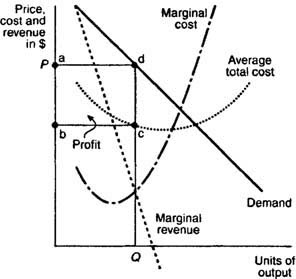
Figure 1
Profit maximization by oligopolistic cartel
Once established, cartels are difficult to maintain. The problem is that cartel members will be tempted to cheat on their agreement to limit production. By producing more output than it has agreed to produce, a cartel member can increase its share of the cartel's profits. Hence, there is a built-in incentive for each cartel member to cheat. Of course, if all members cheated, the cartel would cease to earn monopoly profits, and there would no longer be any incentive for firms to remain in the cartel. The cheating problem has plagued the OPEC cartel as well as other cartels and perhaps explains why so few cartels exist.
source
Motives behind merger and acquisition
These motives are considered to add shareholder value:
Synergy: This refers to the fact that the combined company can often reduce duplicate departments or operations, lowering the costs of the company relative to the same revenue stream, thus increasing profit.
Increased revenue/Increased Market Share: This motive assumes that the company will be absorbing a major competitor and thus increase its power (by capturing increased market share) to set prices.
Cross selling: For example, a bank buying a stock broker could then sell its banking products to the stock broker's customers, while the broker can sign up the bank's customers for brokerage accounts. Or, a manufacturer can acquire and sell complementary products.
Economies of Scale: For example, managerial economies such as the increased opportunity of managerial specialization. Another example are purchasing economies due to increased order size and associated bulk-buying discounts.
Taxes: A profitable company can buy a loss maker to use the target's loss as their advantage by reducing their tax liability. In the United States and many other countries, rules are in place to limit the ability of profitable companies to "shop" for loss making companies, limiting the tax motive of an acquiring company.
Geographical or other diversification: This is designed to smooth the earnings results of a company, which over the long term smoothens the stock price of a company, giving conservative investors more confidence in investing in the company. However, this does not always deliver value to shareholders (see below).
Resource transfer: resources are unevenly distributed across firms (Barney, 1991) and the interaction of target and acquiring firm resources can create value through either overcoming information asymmetry or by combining scarce resources.
These motives are considered to not add shareholder value:
Diversification: While this may hedge a company against a downturn in an individual industry it fails to deliver value, since it is possible for individual shareholders to achieve the same hedge by diversifying their portfolios at a much lower cost than those associated with a merger.
Manager's hubris: manager's overconfidence about expected synergies from M&A which results in overpayment for the target company.
Empire building: Managers have larger companies to manage and hence more power.
Manager's compensation: In the past, certain executive management teams had their payout based on the total amount of profit of the company, instead of the profit per share, which would give the team a perverse incentive to buy companies to increase the total profit while decreasing the profit per share (which hurts the owners of the company, the shareholders); although some empirical studies show that compensation is linked to profitability rather than mere profits of the company.
Vertical integration: Companies acquire part of a supply chain and benefit from the resources. However, this does not add any value since although one end of the supply chain may receive a product at a cheaper cost, the other end now has lower revenue. In addition, the supplier may find more difficulty in supplying to competitors of its acquirer because the competition would not want to support the new conglomerate.
source
http://en.wikipedia.org/wiki/Merger
JIAYOU FOR BLOCKS!
HAPPY HOLS :D
Jasmine
Biofuel blowback: Fifty percent rice price hike could spell trouble
Rising prices and export bans among some producers indicate a crisis may be coming in rice consumption, Asia’s main food staple.
Despite the fact that supplies remain at about last year’s level, since January rice prices on the international market have jumped almost 50 percent, according to a report in the upcoming edition of East-Asia-Intel.
Long-term trends and short-term shocks have collided to produce the price spikes.
Higher incomes across Asia are leading to increased consumption of both rice and meat with more grain being diverted for use as cattle feed.
Production of biofuel — particularly the corn programs in several Western countries, including the U.S. — has put pressure on grain supply.
Also In This Edition
Global rice
stocks are at their lowest since 1976. Rice prices had been slow to follow wheat, corn and other agricultural products moving upward, but a rapid increase started at the beginning of the year. Since January, prices on the international market have risen on almost a daily basis, causing unprecedented market volatility.
“Many people who have been in this business for 30 to 40 years have never seen this kind of market situation in their lives,” said Wanlop Pichpongsa, deputy managing director of Capital Rice Company, one of Thailand’s leading rice exporters. “In the morning rice is at one price, and in the afternoon it’s another,” said Wanlop. “It’s like the
stock market.”
Rice prices have been rising steadily on the world market since 2003, in tandem with oil, and began to shoot up last year as oil approached and then this year surpassed $100 per barrel. But this year’s rice price hike may also be fuelled by something else, which has some observers worried.
The U.S. Department of Agriculture forecasts global rice stocks for 2007-2008 at 72 million tons, the lowest since 1983-1984 and about half of the peak harvest of 2000-2001.
“
I think there is a lot of speculation and a lot of hoarding, because with the dollar going down you don’t want to hold on to currency, you want to park this currency somewhere and where it is parked now is in commodities,” said Shamika Sirimanne, a development policy expert at the UN
Economic and Social Commission for the Asia Pacific (UNESCAP). Around the world, particularly in Asia, governments are moving cautiously to trim exports and in some instances to increase stocks.
China, among several countries in the Asian region that subsidize rice, is facing an increasingly expensive subsidy proposition. It has had record-breaking increasing food costs since August, in large part a result of having to cull swine due to the highly infectious blue ear disease. Now there are likely to be regional shortages of rice. According to early government estimates the recent three-week snow storms caused $7.5 billion in damages, including destruction of winter crops leading to the government’s granting a $700 million relief package for farmers.
...
...
...
Both Vietnam and Cambodia, major exporters, followed India’s lead in March by ordering an increase in stockpiles. Vietnam has been hit by a virus called tungro and infestations of the brown plant-hopper insect. Farmers are complaining that
despite a 50 percent increase in price of rice in the last three months, prices have doubled for fertilizer, insecticides and labor. Furthermore, to curb rising food costs and
inflation, Hanoi has cut rice exports by a million tons this year.
Evaluation
According to the passage, the supply of rice has remained at about last year's level. However, due to an increase in income, the demand for rice and meat has increased. As grain is used as cattle-feed, the increase in consumption of meat causes an indirect increase in demand for rice.
There is also a change in consumer's expectations. Consumers expect currency rates to decrease, therefore they rather invest their money now in commodities like rice. Many people also expect a further increase in rice prices, which is why many people increase their demand for rice now.
All the above factors will cause a rightward shift in the demand curve.

When there is a rightward shift in the demand curve quantity increase from Q1 to Q2 and the price will increase from P1 to P2, thus causing price hike.
 As the price of rice becomes too high, the government has to impose a price ceiling to make sure consumers are able to afford thhe rice. The price falls from P1 to P2 and quantity supplied drops from Qe to Qs. the suppliers will be at a loss. Thus the government most give the producers a subsidy (of the shaded region, P2+S-P1). As price of rice rises, the supply curve needs to shift more in order to meet the demands at Qs and the more subsidies the government has to pay the producers, which causes China's increasingly expensive subsidy proposition
-Xueying
P.S. Sorry for the ugly graphs. And I cant seem to shift them to where I want them to be =P
Income in monopoly sectors 3 times national average
(Xinhua)
Updated: 2006-06-06 14:04
Average wage income of workers in China's monopoly sectors, such as telecom, finance and tobacco industries, has reached three times the national average, while non-wage income of workers in these sectors enlarged the gap with the national average up to 10 fold as much.
"Income is now deviating from the contributions of staffers in the monopoly sectors," said Bu Zhengfa, vice minister of Labor and Social Security, at a recent forum on salary management.
Bu cited an example of a worker in a civic electric power company. His monthly salary approaches approximately 6,000 yuan (about US$750), but his annual income could amount to 150,000 yuan (some US$18,750) with his bonuses, allowances and housing accumulation fund, which could reaches about ten times the national average.
Relatively exorbitant salary of monopoly firms, mostly state-owned ones, has become the most eminent problem of China's income distribution system, Bu acknowledged.
An interview by People's Daily at two leading universities in Shanghai showed that many of their graduates are eager to work in the sectors of tobacco, telecom and petroleum, no matter what positions they might be offered.
"With a guaranteed high salary and job security, I feel secured in monopoly sectors," A university graduate surnamed Wang, who just signed his job contract with a telecom firm, was quoted as saying.
Wang is expecting to earn 4,000 yuan (about US$500) a month upon his entry of the firm, while the monthly salary for his peers is predicted to attain an average of 2,000 yuan (US$250) in these two years.
"Lack of strict regulations constitutes the major cause for monopoly firms to enjoy excess profits," said Prof. Wang Zeke, with elite Zhongshan (Dr. Sun Yates-sen) University in Guangzhou. He suggests the government step up its pace to do away with monopoly and take prompt measures to restrict the profits of monopoly sectors.
In China, the government has stopped levying profits from state-owned firms since 1992 to encourage their development. With relevant preferential policies and their right to use state-owned assets, most state-owned firms enhanced their monopoly status in their respective sectors and enjoyed higher profits over recent years.
The central government has begun taking measures to control the salary scope in monopoly firms. Some telecom and financial companies have even been urged to restrain the salaries for their employees.
Su Hainan, director of the salary research department with Labor and Social Security Ministry, said relevant ministries are considering of collecting more taxes from state-owned firms which have a large proportion of state-owned assets.
This is a very old article but it's still quite relevant so (if you're interested.. you can read on =O)
Evaluation:
Generally people view monopoly as a threat to consumer welfare, as consumers usually have to pay higher prices for a lower output/quantity of products.
China, the big country which has unfortunately just experienced a hugeeee earthquake, has a few monopolistic sectors, which include the telecommunications sector, finance sector etc. It is not surprising to hear that employees who work for firms in monopolistic industries are actually getting higher pays than those who work in other industries (non-monopolistic ones, as we know things like oligopolies do exist). This is due to the fact that monopolies actually have a huge market share, which can be as high as 80-90% (as in Microsoft in the world's desktop market).
As we have learnt from our monopoly lectures and tutorials, in order to become a monopoly, or near one, the firm/firms has/have to have a huge market share (various companies can do so by colluding!) and there shouldn't be close substitutes in the industry so that consumers have no other alternatives to turn to. In this case, there are indeed few alternatives to turn to in the monopolistic industries (e.g. finance, telco etc.). As such, firms in such industries can rejoice because they can earn a lot of money without having to worry much about consumers not choosing to buy their products!
Hence we know now where their money comes from, and how these workers actually earn more than their fellow workers who don't work in monopolistic firms, reaching as high as 3 times the national average!! That's precisely why everyone's rushing to work in such industries.
The same situation probably applies to Singapore as well, but not really evident here (i think!). But for those who really need $$ to pay class fund, can consider working for Singtel or something, maybe they'll give you more smses per month.
Hahahahahahaha i am so sorry for making you all go through my analysis (if anyone's reading! :>)
Happy happy last day of school!!!!!
-Yiling :D
Wednesday, May 21, 2008, 9:32 PM
Hot News // Thursday, April 17, 2008
Who wins in numbers game?
HEDIRMAN SUPIAN hedirman@mediacorp.com.sg
"A SEA change" is what Mr Leong Keng Thai believes full mobile number portability will bring to the local telco industry. And the Infocomm Development Authority's (IDA) deputy chief executive is not alone in expecting a shift of power towards consumers now that a key barrier to switching between operators has finally fallen.
.As it stands, Singapore is well on its way to having a fully-liberalised telecoms market. Subscribers already have their pick of more than 25 mobile pricing plans from the three major telcos, and mobile subscription prices have dropped every year since 1997 — from $47 a month for a basic plan, to as low as $20 today.
.Could plans become even more attractive now?
.With its 5.8 million mobile phone subscribers, the Republic has a penetration rate of 127 per cent. Hong Kong has a mobile penetration rate of 152 per cent.
.Mr Leong said the IDA did an extensive study on "all" markets, and Hong Kong showed the highest annual churn rate — the percentage of subscribers that port their number from one telco to another — of 15 per cent.
.Hong Kong has five mobile network operators and in the past year, these averaged over 110,000 portings of mobile numbers each month. In total, over 1.38 million numbers were ported last year.
.If such figures are any indication of what might happen here, then it is fair to expect the three telcos — SingTel, StarHub and M1 — to offer more competitive prices and plans, in an effort to retain or sway subscribers in an already saturated marketplace. SingTel has 41 per cent of the market, while StarHub and M1 trail with 31 and 27 per cent, respectively.
.But consumers expecting a price war in the long run might be disappointed. Mr Quek Peck Leng, SingTel's executive vice-president (consumer), said: "Offering the best value through all our various offerings and providing the best possible service experience have always been our top priorities. Ultimately, it does not make sense for us to engage in a destructive price war and destroy value."
.Mr Foong King Yew, a research director from Gartner, said: "It has happened in Australia, Hong Kong, Korea and Japan — there will be an increase in the churn rate for the first 12 to 18 months. This will stabilise eventually."
.Mr Adit Harinasuta, StarHub's head of services and solutions, said: "We do not foresee full mobile number portability having a significant bearing on customer churn. We believe that cultivating loyalty will be a key focus for all operators."
.Mr Foong expects telcos to "go into product or service bundling and offer handset subsidies" to offset the attraction of consumers being able to switch operators without the hassle of changing numbers.
.SingTel already bundles broadband, mobile phone and pay-TV services with its mio service and StarHub does a similar bundle with its Hubbing concept.
.M1 has matched its competitors by offering per-second billing and savings for subscribers with multiple accounts. "Carriers will strive to hold onto their existing customers with more focus on service packaging. But I don't expect them to be draconian in their tactics," Mr Foong said, referring to the concern that telcos might impose more drastic penalties for contract termination.
.As barriers are lifted for consumers, the IDA hopes new players will come in. Wireless broadband providers or Voice-over-Internet-Protocol providers could provide mobile voice calls routed through the Internet, it said.
.But the odds are against new entrants.
."The market is very mature, and stacked against new entrants because the existing players already have service and product bundling, and post-paid contracts are already in place," said Mr Foong. "New entrants have to come up with something compelling or disruptive."
.This is not impossible.
.Japan - where prices for voice calls have been traditionally high - has seen an industry shake-up thanks to daring price moves and better product offerings.
.No 3 mobile operator SoftBank has intruded on the turf of market incumbent NTT DoCoMo, by bringing prices for voice calls down. Its advertising campaign even featured a zero-yen tagline for its mobile service. KDDI, another smaller player, has lured subscribers with better mobile handsets and being first-to-market with multimedia download services.
.It would be wise, perhaps, for the big telcos to keep their ears close to the ground in their battle for market share, as consumers are likely to demand more competitive prices and innovative services.
.Ms Laura Khng, a public education executive, said: "I can't wait to switch. Ultimately, I want lower prices, but if they want me to stay with them, they may need to offer better loyalty rewards and cooler products.
."Consumers are better informed these days. It's easy for us to compare and spread the word around when there's a good deal. The operators should take heed of that."
My take on this issue:
DEMAND AND SUPPLY
In singapore, the 3 main telcos offer up to 25 or more different pricing plans for customers. With more plans available now, supply increases(supply curve shifts right), demand stays roughly the same and thus the equilibrum price falls ($47 per mth to even $20 per mth now)
PED
In the past, it was prohibitively costly and very troublesome for customers to switch from one hp service to another as they needed to change their numbers all over again, but now with this new ruling of hp porting made legalised, it has greatly reduced the hassle and cost involved for switching services. They can stick with their present numbers. Customers would always choose the best plan with the most possible savings. When they feel that their present hp contract is not to their liking, they can now easily switch to another more attractive plan by another telco. This greatly reduces barriers for customers. They now have a more price elastic demand, since substitutes are extremely available. A small increase in pricing will result in a more than proportionate decrease in demand, resulting in lower revenue. Therefore, the best option for telcos will be to lower prices so that there will be a more than proportionate increase in demand for their plans. This will result in a rise in total revenue.
CED
Since the plans offered by the various firms are similar in a way (eg. same per minute rates, same no. of free smses etc), with the new hp porting policy introduced, this makes their products ALMOST perfect substitutes of one another. They have a positive CED. When the price of 1 firm's plan falls, the demand for the rival firms' plans decrease too. Therefore, certain strategies are employed by the firms. Firstly, when rival firms cut prices, they follow suit and slash prices too. Secondly, they differentiate their products so as to reduce the degree of substitutability between their products and those of the rival firms'. For eg, "SingTel already bundles broadband, mobile phone and pay-TV services with its mio service" while "M1 has matched its competitors by offering per-second billing and savings for subscribers with multiple accounts". These will ultimately increase the revenue for the firms.
MONOPOLY
Eos
The only present local telco giants are namely, Singtel, Starhub and M1, Who have 41%, 37% and 21% of the mkt share respectively. The whole singapore mkt is supplied by these 3 firms solely. They have a certain degree of monopoly power. They have invested heavily due to the high fixed costs required to build up the telecommunications infrastructure in singapore. Presently, these few firms can reap substantial EOS with LARGE output. The MINIMUM EFFICIENT SCALE is reached at a very large output. The firms have incentive to expand production to enjoy even lower average production cost per unit. Should there be many more firms supplying the mkt together, the total output would be shared amongst all the firms, resulting in lower output per firm. They would then not enjoy substantial EOS as that enjoyed by the 3 firms now.
Barriers to entry
-"The market is very mature, and stacked against new entrants because the existing players already have service and product bundling, and post-paid contracts are already in place," said Mr Foong. "New entrants have to come up with something compelling or disruptive." The existing frims already have many innovative products that will appeal more to customers than uncreative, common gds. They have contracts that will bind existing customers to their companies for a period of time. Their R&D increases customer satisfaction and allows them to build up a loyal customer base, who would stick more with their products. It is not easy for new entrants to "steal" those loyal customers away from the large firms.
-Morever, the large firms can fund the huge fixed costs (mentioned earlier) much more easily than those smaller firms with little capital.This will also deter new companies from entering the mkt as they would incur huge fixed costs immediately upon starting business. Sometimes, these are not just fixed costs. They are "sunk costs", which cannot be recovered should the firm close down, or cannot be easily transferred to other uses. There is a high risk of entering and high risk of failure, which will deter potential entrants.
-Also, the substantial EOS reaped by the large firms in the oligopoly can be translated to lower pricing, which new entrants cannot match up to, thus preventing them from entering the industry.
However, it is still possible for new entrants to brk into the mkt share of existing firms, if they come up with creative, feasible or even daring business strategies. For example, the passage mentioned about No 3 mobile operator SoftBank has invaded into incumbent NTT DOCOMO's mkt share by bringing prices for voice calls down. KDDI, another smaller player, has lured subscribers with better mobile handsets and being first-to-market with multimedia download services. These new firms differentiated their products from those of the existing firms' and thus produced a niche mkt for themselves.
ah, now i can slp in peace wif no more worries abt econs blog.
Yu zheng
What Spurred the Run on Rice
Tuesday, May 20, 2008, 10:10 PM
Sherry's post!
At the Costco (COST) in San Francisco, rice is all the rage. Not long after the 10 a.m. opening on Apr. 24, the warehouse club was well on its way to selling out the day's supply of Thai jasmine rice. Real estate broker Mary Jane Galviso managed to snap up two 50-pound bags—the limit imposed by this particular store. "This is very frightening," says Galviso, a Filipino-American who made the more than 200-mile trip from her hometown of Orosi, in California's Central Valley, where her local grocery was out of Thai rice.
Rice, a lowly staple, has suddenly turned into a hot commodity. Some Costco and Wal-Mart (WMT)-owned Sam's Club stores have begun limiting purchases of premium varieties, such as Thai jasmine and Indian basmati, in response to panic buying from individual shoppers and restaurant owners.
The rationing is but one manifestation of the global food crisis. Around the world, prices for rice are starting to hit record highs: Thai rice, the benchmark, is hovering at around $1,150 per metric ton, compared with about $320 at the end of last year. That's puzzling since worldwide rice production was up in 2007, with Vietnam, Thailand, and India all logging bumper crops.
What has actually sent rice prices spiking in recent months are artificial shortages. Countries such as India and Vietnam, the world's No. 2 and No. 3 rice exporters, have imposed limits or outright bans on rice shipments in order to shield their populations from the effects of soaring food costs. That in turn is hurting net importers of the grain, such as Iran and the Philippines. On Apr. 15, the Philippine government tried to buy 500,000 tons of rice in the global market but managed to get only 320,000 tons. The news sent shock waves through the wholesale markets.
With rice prices climbing ever higher, there's
plenty of incentive for everyone from traders to millers to store owners to stockpile the stuff. "You've seen a lot of
speculators coming into the market and making things even worse," says Chookiat Ophaswongse, president of the Thai Rice Exporters Assn.
At the Chicago Board of Trade, the traditionally sleepy market in rice futures has been jolted awake. Says Tim Hannagan, senior grain analyst at Alaron Trading in Chicago: "I've never seen a rice [futures] market until this year in my three decades of trading grains."
With Tom Giles in San Francisco and Frederik Balfour in Hong KongGogoi is a contributing writer for BusinessWeek.com.EVALUATION:Rice prices for premium and basic brands have gone up by up to 14% in recent weeks, caused by a surge in global demand for grain, poor harvests and increasing cost of production.
However, the author claims that the main reason behind the price hikes in rice are artificial shortages. I feel this is true to a certain extent as factors such as speculation on the market has led to consumers rushing to buy rice in anticipation of further increases (panic buying). It brings a new perspective to this issue, that maybe people are making a mad scramble for nothing.
Indeed, this is what someone posted on the forum at BusinessWeek.com:
Dave May 2, 2008 1:08 PM GMT
There is no shortage of anything, just manipulation of supply to demand more of a price increase from everyone else.
Jared Lorz May 5, 2008 6:21 PM GMT
There is no food crisis, there is no impending doom. This is just the latest Y2k Rapture load of crap the media is selling to manipulate the stock market.
Personally, I feel that the speculation has a large part to play in driving up prices. With increased quantity demanded, the price in rice will then be expected to increase. However, this speculation is not without basis, as there have been reports about how droughts have affected agricultural output, and hence led to a decrease in supply.
This is something we can all ponder over.
Sherry
The subsidies also outstrip Indonesia's total social spending and capital investment, according to the World Bank. -- AFPLearning points:
1) type of tax imposed : specific/per unit tax
à in this case, an increase of 1500 rupiahs per litre
2) since demand is relatively price inelastic, the decrease in subsidies (or in another light, increase in taxes) would be borne more by the consumers

<3 MEL!
GP HOMEWORK (don't sigh!)
okay finally sth that's non- econs -- a very impt msg from ms ng:
Dear all,

Holidays are coming. I know you're going to have great fun, but to
prevent any human tragedies during the Blocks, I have to prescribe 3
sets of homework for GP.

1) Time Tunnel (Please complete ALL exercises)
2) Issues and Ideas (To be distributed this week)
3) Data Bank --> Please collect 8 articles. Highlight/extract facts.
Would be best if you process the information into usable bites for
your essays. I also advice you to work on your pet topics (about 4)

That's all! Please pass this message around.


- renice(:
Singtel-Starhub duopoly
Saturday, May 17, 2008, 2:54 PM
The more the merrier
Sun, May 11, 2008
The Straits Times
Broadband users who complain about slow speeds and high prices here often point to one thing - the SingTel-StarHub duopoly.
The two dominant telecoms operators own almost all the cables here that carry our phone calls, Internet data and pay-TV programmes.
Every company that wants to offer an Internet service will most likely have to route traffic through the two telcos, and as a result, pay a part of the earnings to them.
Some service providers have tried building smaller networks and tapping onto SingTel and StarHub's when needed. But all they ended up with, if you asked Pacific Internet, were often meagre pickings after paying off the big boys.
Why not build a rival new network? Until now, that was too expensive for a new entrant.
As events unfolded last week, Singapore came a step closer to a new network that will be shared by many providers at a fair price. For users, it means more competitive offerings.
Two groups of companies, made up of both old hands and new players, put up their bids to build Singapore's new cyber highways last Monday.
Both plan to lay fibre-optic cables, which can carry an almost infinite amount of data for decades to come, to homes. They will deliver a myriad of services like high-definition TV, 'life-like' videoconferencing and tele-medicine.
The technology has already been rolled out in Japan, Hong Kong and other well-wired places. Singapore will be next, in as early as the next two years.
More importantly, emerging along with the newfangled technology is a seismic change in the market. More competition has already come in the past two years, after the Government injected funds into projects like Wireless@SG.
The free Wi-Fi hotspot project cost $30 million in public funds, but has given users thousands of places to surf for free.
Even more ambitious now are the new cyber highways, dubbed Next Generation National Broadband Network and costing up to $1 billion in state funds.
In exchange for financial help, no single telecoms operator can own the entire network, in an 'open access' arrangement. One company will lay the cables, another will operate the switches, and others will sell services to users. While there are only two bids for the first part of the project - to lay the cables - what is heartening is that there are newcomers to the game, with new ideas.
Leading the OpenNet group is not SingTel but Canada's Axia NetMedia, which has teamed up with SingTel, Singapore Press Holdings and SP Telecommunications.
Axia is known for its work in Canada, where it runs a similar open access network that grew out of a government plan in 2001.
Then, in Alberta, Canada, there were only a few service providers. Now, after an open access network was set up, there are 91 service providers hooked up to Axia, serving 242 communities, including some which had only dial-up Internet previously. Schools, libraries and even hospitals can now tap into this network, called Alberta SuperNet, to videoconference or to share ideas on 'remote' whiteboards where information is sent over the Internet.
There is another important outcome of the bid. SingTel, the largest telco here, will not dominate the market like now, even though it has a 30 per cent stake in OpenNet.
If it wants to deliver its mio TV service, or any other service, over the network, it will have to pay the same amount as any newcomer to the market.
The hope is that small firms, like the ones offering online games or niche TV programmes, can use the network to deliver their services. In the past, they would have had to work on SingTel and StarHub's terms.
If Axia has the expertise of running an open network, then City Telecom has that of laying fibre-optic cables in high-rise Hong Kong apartment blocks that are not unlike those in Singapore.
While rivals are still stuck with speeds of about 25Mbps, City Telecom has zoomed ahead with offerings of 1,000 Mbps.
Hong Kong has always been held up by users here as a model when it comes to broadband services. With the fastest broadband link there, a movie takes just minutes to download. Here, we're talking about hours.
From what has unfolded so far, the stage seems set for an opening up of the market like never before.
Even if SingTel or StarHub, should they lose in their bids, resort to setting up their own ultra-fast networks, measures are being put in place to prevent them from returning to their old dominance.
Just last month, the Infocomm Development Authority proposed new rules that would put the same 'open access' restrictions on a network funded and built by StarHub or SingTel.
This means they will be forced to open up that network to rivals despite spending their own money. Even before the rules have come to pass, they are already having some effect. SingTel Singapore's chief executive officer Allen Lew said last Monday that telcos should be looking to a future when they earn their revenues from services, instead of holding on to infrastructure to dominate the market.
There will be problems, certainly. There will be people upset by the hassle of wiring up their homes, just as there were when cable TV was introduced more than a decade ago.
What will people do with the speed? Will they stick to existing broadband services? For now, there are no sure-fire answers.
Speeds will be faster - 10 times faster for a start - and prices will fall with more players joining the fray.
After years of having little to choose from, that is indeed good news.
Broadband users who complain about slow speeds and high prices here often point to one thing - the SingTel-StarHub duopoly.
Alfred Siew
siewtha@sph.com.sg
Indeed, currently there exists a Singtel-Starhub duopoly in Singapore. These two companies are enjoying great monopoly power in the internet service market. Furthermore, the internet service market is crucial in the economic growth and the running of day to day activities. Hence, the reliance of the both the country and the population on the Singtel-Starhub monopoly gives the two giants enormous power and freedom in the way they run their business.
Why is this so? The most obvious reason to the Singtel-Starhub duopoly in Singapore is the huge amounts of startup costs. This means that the barriers to entries an industry such as this one is extremely high. This is especially so since it is expensive to run cables throughout the island such that every household is able to enjoy internet and television services. High barriers to entry also indicates high barriers to exist. Should a company start up and realize that they are unable to compete with the two existing teleco giants, folding up might consume a great amount of asset. Hence, companies would think twice before entering the boardband industry. This gives Singtel and Starhub their monopoly power.
Also, these two companies are able to enjoy Economies of Scale(EOS) such as technical EOS. This is so because the equipment that they use can serve two purposes at the same time, hence reducing costs greatly. For example, Starhub uses its cables that it has setup island wide to provide both Cable TV services and boardband services.
This is especially important since this industry has a LRAC curve whereby MES is high. Hence, small firms that just start up are unable to compete on equal footing. For instance, Pacific Net’s business is unable to flourish in Singapore because they have to route their service through the two big telcos and pay them part of their earnings. Hence, it becomes much less profitable for smaller companies such as Pacific Net. Also, the two large companies enjoy government support to a certain extent, hence they are almost impossible to compete with.
Many have started to criticize both companies for the services they provide as they pale in comparison to services in Japan and Hong Kong. The question is: Are they really suffering from X-inefficiency because of their duopoly power?
This may be the case because of the relatively slow speed of boardband service that Singaporeans have excess to. As the article writes “With the fastest broadband link there, a movie takes just minutes to download. Here, we're talking about hours.” In a fast pace society like Singapore, such inferior services in the boardband market is unacceptable. Technology for fast and inexpensive boardband services has already been available to the market for some time, hence there is little excuse to continue providing the conventional boardband service to Singapore users.
However, both Singtel and Starhub have been engaging in fierce competition , and this very obvious and transparent to the population. With simple glace through the weekend newspaper, the handphone advertisements would enable any reader to see that both companies have been putting in considerable amounts of effort into improving service standards and reducing prices. In fact, not too long ago, Starhub provided free 1000mbps upgrade to a majority of its users. Hence, it might not be so that service standards are not comparable to those which other countries enjoy because of X-inefficiency.
The government in Singapore is now hoping that through the “Open access” system that they plan to put into place, they are able to control the monopoly power that huge firms have over the smaller ones. Hopefully, monopoly power of the two large firms will be reduced such that the market will become more “healthty”.
By Derrick



 I remember how excited i was to see this poster at Cathay until i saw the following:

